Powell Under DOJ Pressure
BTC is still rangebound near $90K, briefly touching $92K in Asia before slipping back to about $90.7K, as markets weigh tariff uncertainty, a mixed December jobs report and tomorrow’s CPI. Despite the macro noise, US equities ended last week at record highs and Fed speakers signalled only incremental policy adjustments, with traders leaning toward no change at the end-of-January meeting. Crypto ETF flows were mixed with heavy BTC and ETH outflows, while XRP stayed net positive and set a weekly volume record, as SOL and DOGE cooled and LTC returned to inflows. Policy risk rose again with DOJ subpoenas targeting the Fed, Dubai tightening DIFC crypto rules including a privacy-token ban, and South Korea moving toward reopening corporate crypto trading under a 5% cap.

Find out our latest reports, listed below:
Market Snapshot: Overnight Moves

Daily Updates:
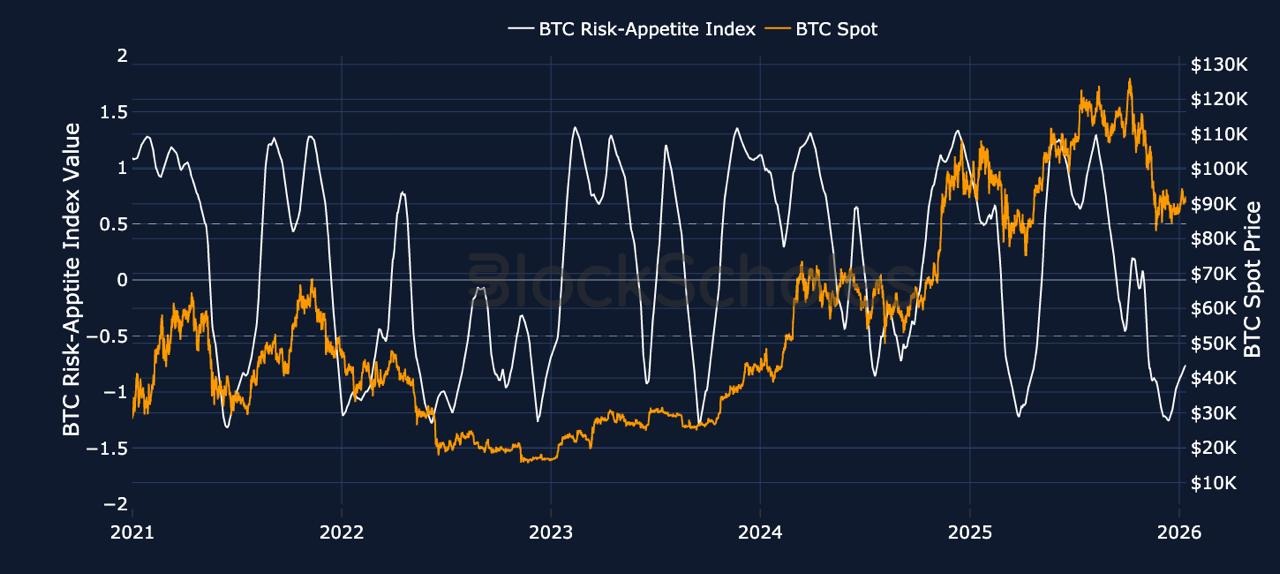
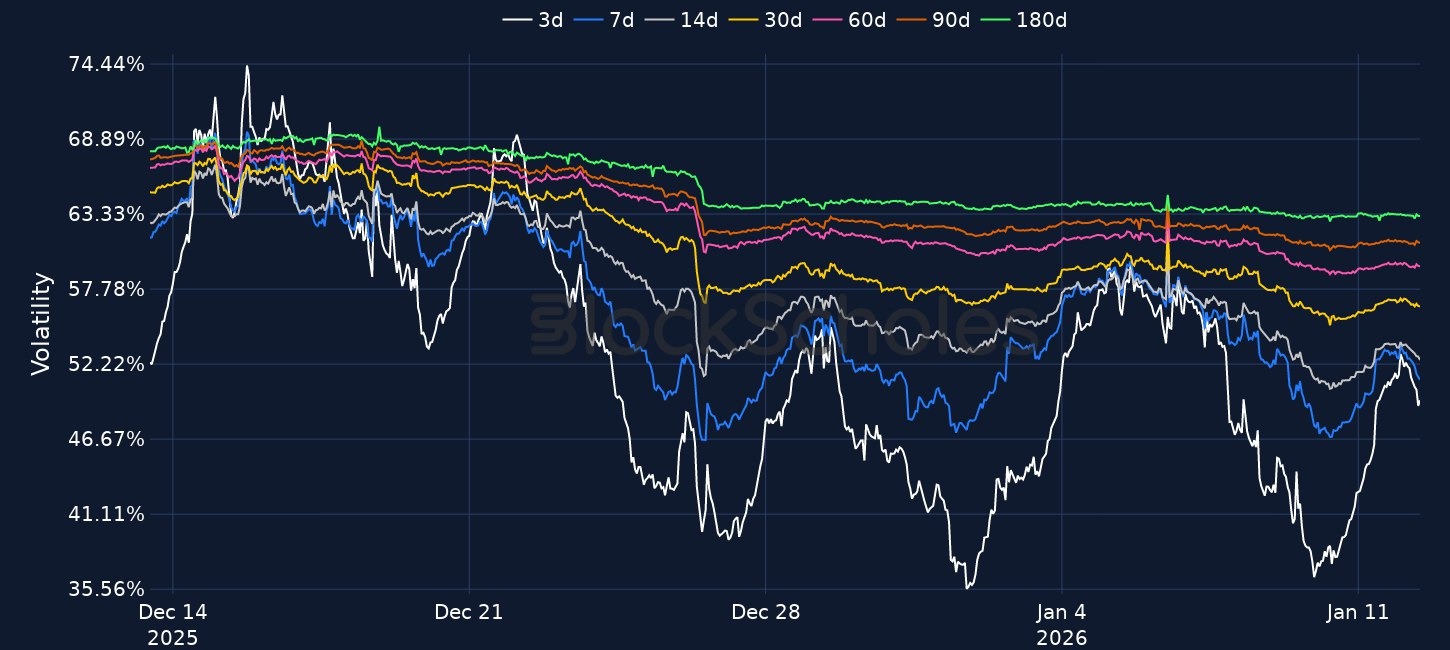
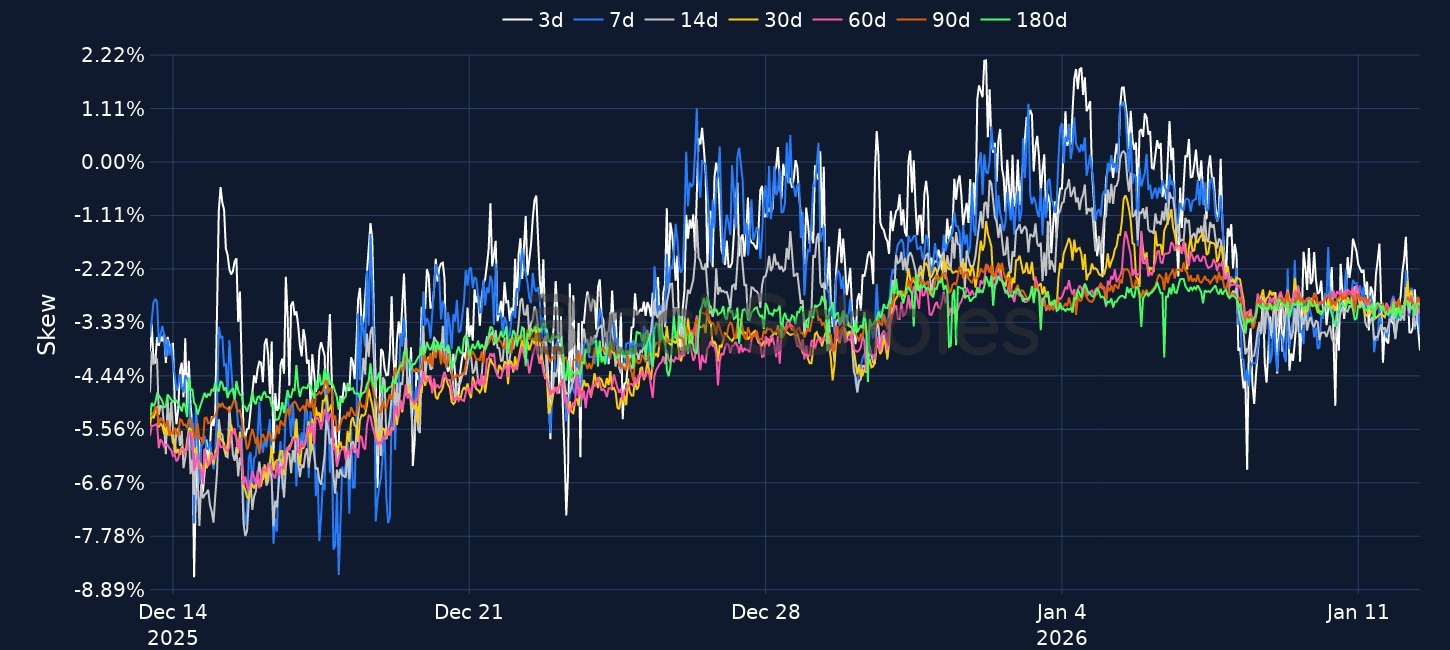
- After a weekend of rangebound trading at $90K, on Monday morning in Asia BTC briefly rose to $92K before falling back within range. It currently changes hands at $90.7K.
- The current sideways trading in BTC has occurred despite the past week seeing notable macro developments.
- First, last Friday, the US Supreme Court ended up not delivering what was a highly anticipated decision on the legality of President Trump’s reciprocal tariffs — which were imposed under the International Emergency Economic Powers Act. The Court said that Wednesday 14 Jan, 2026 would be the next opinion day on which a ruling may be announced.
- Even if the Supreme Court ends up ruling against President Trump, his National Economic Council Director Kevin Hassett told Fox News last Friday that the administration has “got a very, very detailed backup plan”. According to Hassett, “We’re confident that if we were to lose this case, that we can get all of the president’s policies in place almost immediately with alternative authorities”.
- Secondly, a mixed nonfarm payrolls report for December reinforced bets amongst traders that the Fed will leave interest rates unchanged in their end-of-January meeting this month (while still pricing in two cuts for the year).
- The report showed that US employers added fewer jobs than expected in the final month of 2025 — nonfarm payrolls rose by 50,000, against an expected 70,000, while the October and November numbers were downwardly adjusted by 76,000 in total. On the other hand, the unemployment rate, which Fed members have kept a keen eye on, came in lower than expected. The unemployment rate in December fell to 4.4%, against expectations of 4.5%, while the November rate was downwardly revised from 4.6% to 4.5%.
- Over the full year of 2025 payrolls climbed by 584,000, making it the weakest year for job gains since 2020. Additionally, the number of Americans who are long-term unemployed (or out of work for 27 weeks or more) rose by nearly 400,000 last year, also the most since Covid.
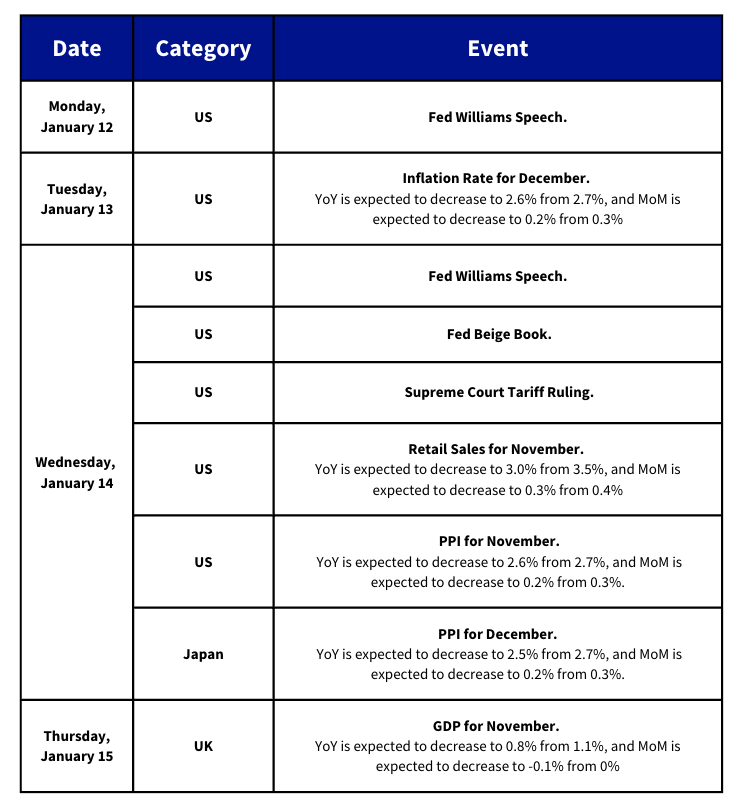
- Markets will have the chance to balance the NFP report with a CPI report due tomorrow. Current expectations are for core CPI to increase 2.7% in December 2025 year-over-year, slightly higher than the 2.6% advance in November.
- Wall Street was able to brush aside all of that volatility on Friday and closed at record highs. The S&P 500 rose 0.6% to a new high, while the Nasdaq-100 advanced 1%. Small-cap US equities also rallied — so far this year, the Russell-2000 has outperformed all major US stock indexes as traders start 2026 expanding beyond Mag-7 and Big Tech.
- Speaking after the NFP release, Richmond Fed President Barkin told reporters that the “fine balance between a modest job growth environment with a modest labour-supply growth environment seems to be continuing, and that was encouraging”. He added that “Inflation has been above our target now for almost five years. It’s in a lot better shape than it was two or three years ago, but it’s certainly not all the way there”
- In a separate interview on Friday, San Francisco Fed President Mary Daly said “We’re not in a place where we’re making large policy moves. We’re in a place where we’re fine tuning as the economy evolves”.
- In the first full trading week of 2026, there were significant outflows from BTC and ETH ETFs of about $681M and $750M respectively.
- XRP ETFs went the other way, finishing the week with $38.1M of net inflows despite a $40.8M outflow on Jan 7, and set a new weekly trading-volume high at $219M.
- On the other hand, SOL broke its eight-day inflow streak, finishing with no inflows on Jan 9. DOGE was also flat on Friday, after having $333.4K of inflows the day before. LTC had $396.95K of inflows on Friday, its first inflow day since Nov 28, 2025.
- Geopolitical tensions continue to remain rife. Over the weekend President Trump signed an executive order designed to further control sales of Venezuelan oil by declaring a national emergency. The executive order seeks to safeguard Venezuelan oil revenue held in US treasury accounts, blocking it from the Latin American country’s creditors and preventing its seizure to satisfy debts or other legal claims.
- Iran also warned the US not to intervene in its local matters. The past two weeks have seen widespread protests and demonstrations erupt in the region, stemming originally from high inflation in the country and a depreciation of the Iranian Rial. According to the IMF’s October 2025 outlook report, inflation was expected to average 42% in 2025, while the Iranian currency fell 45% against the US dollar last year, and recently hit a record low in early January.
- President Trump has posted on Truth Social that the US is “locked and loaded and ready to go” and that “The USA stands ready to help!!!”.
- On Sunday he told reporters “We’re looking at it very seriously. The military is looking at it, and we’re looking at some very strong options”, while also claiming Iran has reached out to the US to seek talks.
- In a continuation of the US administration's attack on Fed independence, the Justice Department served the central bank with grand jury subpoenas, threatening a criminal indictment.
- On Sunday, Chair Powell released a video where he claimed that while the focus of the subpoenas were related to comments he made in a June congressional testimony in 2025 about ongoing renovations of the Fed’s headquarters, the move “should be seen in the broader context of the administration’s threats and ongoing pressure.”
- Powell said “The threat of criminal charges is a consequence of the Federal Reserve setting interest rates based on our best assessment of what will serve the public, rather than following the preferences of the president” and that “This is about whether the Fed will be able to continue to set interest rates based on evidence and economic conditions — or whether instead monetary policy will be directed by political pressure or intimidation.”
- The Chair also made reference to the fact that he has “served at the Federal Reserve under four administrations, Republicans and Democrats alike” and that “In every case, I have carried out my duties without political fear or favor, focused solely on our mandate of price stability and maximum employment.”
- The US dollar fell to a three week low following the announcement, while gold prices extended 2% to another record high. S&P 500 futures on the other hand slipped 0.7%.
- Dubai Financial Services Authority (DFSA) announced today that it has tightened its crypto rules for the Dubai International Financial Centre (DIFC), banning privacy tokens and restricting privacy tools like mixers on AML and sanctions-compliance grounds.
- It also narrowed the stablecoin category so fewer tokens qualify to fiat-backed tokens backed by high-quality, liquid assets capable of meeting redemption demands during periods of stress.
- At the same time, the DFSA is moving to a firm-led suitability approach, making licensed companies responsible for approving and continuously reviewing the tokens they offer.
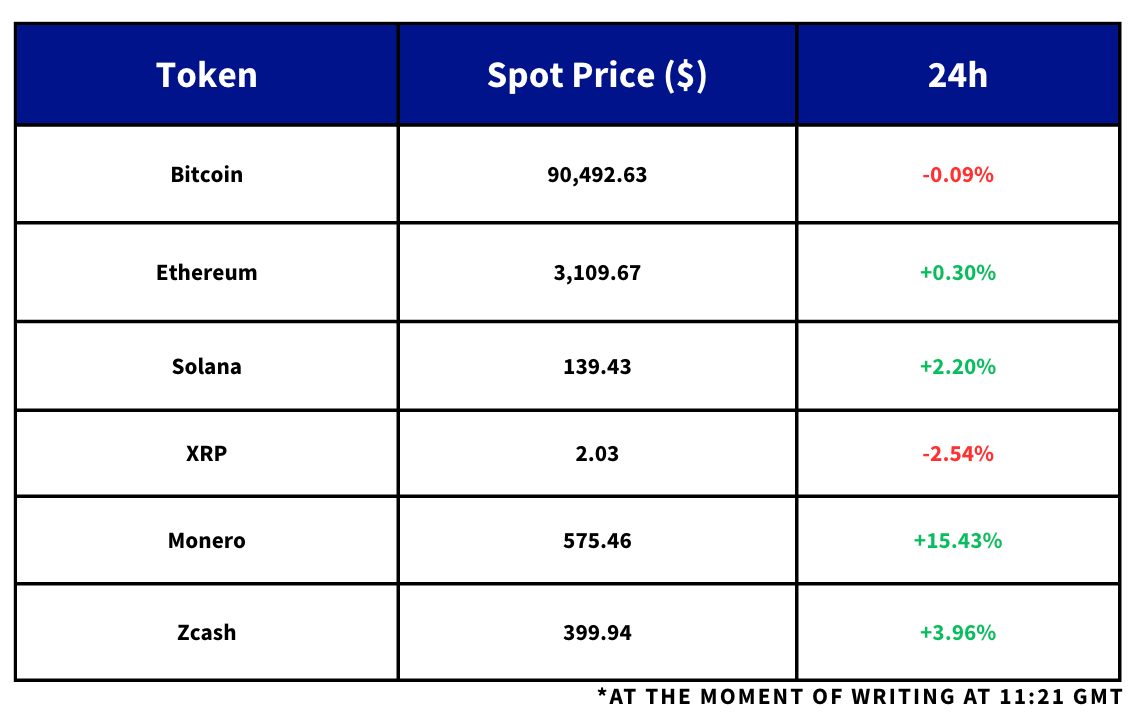
- Privacy coins reacted relatively neutral rather than panicking: Monero jumped 16% over 24 hours, while moves elsewhere were modest, with Zcash up 0.36%, Litecoin up 0.89%, Canton up 1.83%, Midnight up 0.88% and Tezos up 0.24% at the moment fo writing.
- South Korea’s Financial Services Commission announced yesterday it is preparing rules to reopen corporate crypto trading, including a 5% cap on the share of a company’s equity capital that can be allocated to digital assets each year.
- The draft would limit eligible buys to the top 20 tokens by market cap, with stablecoin inclusion still under discussion.
- The guidelines could start in practice as early as January-February 2026, with corporate trading expected to begin within this year.
This Week’s Calendar:

Charts of the Day: